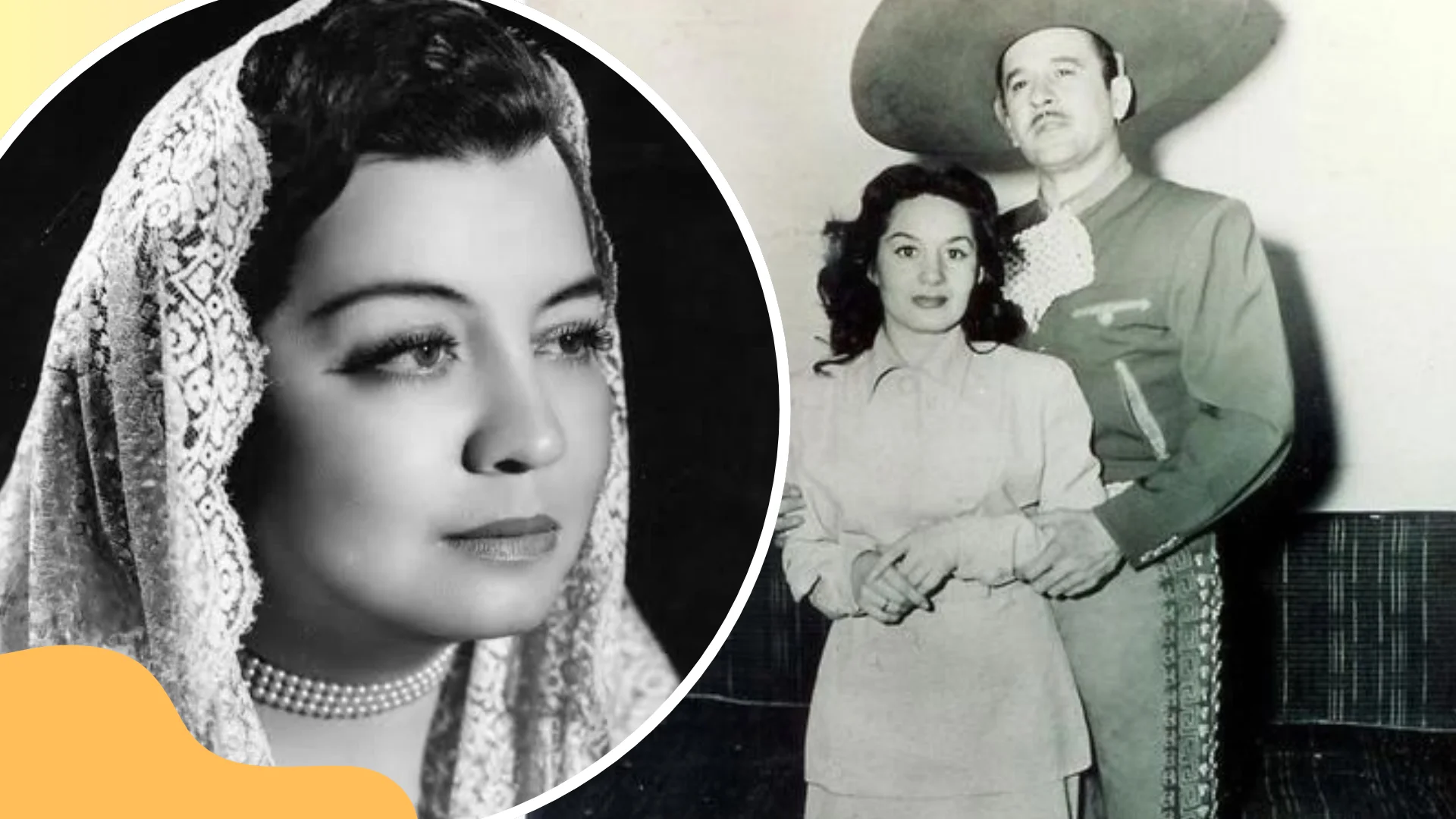
The name Maria Luisa Leon appears on a surprising number of web pages. Some look like biographies but are really generic, auto-generated text with no verifiable detail. One claims she was born in Madrid in 1985, which has nothing to do with the woman most people have in mind.
The Maria Luisa Leon people usually mean is the first wife of Pedro Infante, one of the most beloved figures in Mexican entertainment history. Her story has been retold in Mexican media and dramatized in the series Se llamaba Pedro Infante, where she is played by Ana Claudia Talancón. This post draws on what has been reliably reported about her, flags where details are uncertain, and asks why a woman so often described as a footnote in someone else’s life keeps drawing readers back.
Why Maria Luisa Leon Still Draws Curiosity
Pedro Infante died on April 15, 1957, in a plane crash near Mérida, Yucatán, at the height of his fame. Nearly seventy years later he is still a cultural institution in Mexico. His films play on television, his songs are sung at family gatherings, and his grave in Mexico City draws visitors every year.
Because his life was so public, the people around him became public too. Maria Luisa Leon is one of the most discussed. Interest in Maria Luisa Leon is partly curiosity about the man, but it is also curiosity about the woman who knew him before the fame, shared his early struggles, and then watched his life fill up with other people.
Univision’s retrospective calls her the only wife of Pedro Infante and an important figure in his life and career. That description captures the core of her story: she was legally married to him when his star rose, and she was part of the world he came from.
The Beginning: Maria Luisa Leon and a Young Singer
The love story of Pedro and Maria Luisa Leon is usually told as beginning when Pedro was about 19 years old. The story goes that María Luisa investigated where Pedro would perform after his radio work, because she was determined to meet him in person.
That detail is worth pausing on. It paints her as an active participant in the story, not a passive figure waiting to be noticed. She saw a young man with a remarkable voice and went after the chance to meet him.
The setting matters too. Pedro Infante was born in Mazatlán, Sinaloa, in 1917 and grew up in Guamúchil, in a modest family. He was a working-class kid who learned carpentry and music, and he played in local bands before moving toward radio and eventually film. The relationship began before any of the glamour that later defined him. When two young people meet in a small town in northwestern Mexico in the 1930s, they are not planning to be part of a national legend.
Reports say that from the moment they met, both showed a strong interest in each other. They married around 1939, and by most accounts this was a love match, not a strategic one. Pedro had no fame to leverage, and María Luisa had no reason to marry him except that she wanted to.
Maria Luisa Leon and the Lean Years Before Fame
Reporting often describes Maria Luisa Leon as key to Pedro’s rise, and the phrasing makes sense even if the specifics are hard to pin down. Careers like his are rarely built alone. In the late 1930s and early 1940s, Pedro was trying to make a living as a singer while working toward radio opportunities in Mexico City. That kind of path takes years of uncertain income, travel, rejection and small gigs.
A spouse in those years is often the person who absorbs the instability: the money that isn’t there, the nights alone, the confidence that has to be borrowed when a performer is doubting himself. Whether Maria Luisa Leon filled that role in every detail is hard to say from public records. But the broad outline, a young wife standing by a musician before success, is consistent with how Mexican accounts of the period describe her.
It’s worth being careful here. Many popular retellings drift into romanticized storytelling, and some of the more dramatic claims circulate without clear sources. When reading about Maria Luisa Leon, ask whether a claim comes from a named journalist, a documented interview, a family statement or a biography, or whether it simply appears across many websites with the same wording. The last kind is usually the least reliable.
How Fame Changed Everything for Maria Luisa Leon
Pedro Infante’s career took off in the 1940s, during what film historians call the Golden Age of Mexican cinema. He became a leading man, a singing star and a symbol of a particular kind of Mexican masculinity: charming, humble, funny and warm. Films like Nosotros los pobres and its follow-ups made him a household name across Latin America.
That fame had a cost at home. Touring, filming schedules and constant public attention strained his private life. According to Univision’s account, the relationship was not free of difficulties despite the love Pedro felt for María Luisa.
Here the story turns into the part that many readers have in mind when they think of her. Pedro entered other relationships, notably with Irma Dorantes and Lupita Torrentera. At the start of these romances, both Irma and Lupita reportedly did not know that Pedro was married to María Luisa.
This was not a small matter. For Maria Luisa Leon, it meant learning that her husband’s public image, the devoted and humble man millions admired, did not match what was happening privately.
The Anniversary Phone Call and Maria Luisa Leon’s Confrontation
One of the most repeated episodes in her story concerns a moment of discovery. On the occasion of her eighth wedding anniversary, María Luisa received a phone call that confirmed her suspicions of infidelity.
Whether you read that as tragic, humiliating or simply human, it’s a vivid scene, and it explains why her story resonates. An anniversary is supposed to mark continuity, and here it became the moment of rupture.
Afterward, Maria Luisa Leon confronted Lupita, who admitted she had not known Pedro had a wife. The detail is interesting because it complicates the usual villain-and-victim framing. Lupita, too, appears in these accounts as someone who had been kept in the dark. The person at the center of the web was Pedro, and the women involved were each dealing with the consequences of his choices.
Meanwhile, Pedro kept promising María Luisa eternal love. That tension, declarations of loyalty alongside a parallel life, is what makes the story so enduring in Mexican popular memory. It suggests a man who may have genuinely loved her and still could not or would not do what that love required.
Maria Luisa Leon and the Divorce That Never Came
The most contested part of her story is the question of divorce. According to the reporting, there are two competing versions. María Luisa maintained that Pedro was the one who didn’t want to separate, while people close to Pedro blamed María Luisa for refusing to grant the divorce.
This is the kind of dispute that can’t be resolved from the outside. Each side had reasons to tell the story in its favor. Pedro’s circle had an interest in protecting the reputation of a man who had become a national icon, and María Luisa had an interest in not being cast as the obstacle to his happiness.
What we can say is that the marriage was never legally dissolved, which is why Maria Luisa Leon is remembered as his only legal wife, even though he built other family relationships. That legal reality shaped how people have talked about her ever since. In a period when divorce carried heavy social and religious weight in Mexico, staying married carried its own meaning, whether it was stubbornness, faith, hope or something else.
Despite the ups and downs, the retelling says Pedro always loved and valued María Luisa, and that she held firm and never thought of leaving him. Whether that portrait is fully accurate or partly softened by nostalgia, it’s the version that has settled into public memory.
Maria Luisa Leon: More Than a Wife
One headline in the Univision piece describes her as more than a wife, and that phrase points to something real about how her role is understood. She wasn’t just a name on a marriage certificate. She was there during the years when Pedro was still becoming himself.
There’s a pattern in the biographies of famous men where early partners get reduced to a single role, the first wife, as if their whole identity were defined by being replaced or overshadowed. Reducing Maria Luisa Leon to the wife who was cheated on or the wife who wouldn’t grant a divorce does her the same disservice. She was a person with her own decisions, her own pride and her own reasons.
Consider what is attributed to her: she sought out Pedro rather than waiting to be noticed, married a young musician with uncertain prospects, confronted the situation directly when she discovered it, and did not walk away from the marriage, whatever one thinks of that choice. Those are the actions of a woman with agency, even when circumstances were painful.
Maria Luisa Leon on Screen
Pedro Infante’s life has been dramatized many times, and the series Se llamaba Pedro Infante brought renewed attention to the people around him. Ana Claudia Talancón is the actress who plays Maria Luisa Leon in that series.
Dramatizations are a double-edged sword for understanding real people. They make the story accessible, and they bring forgotten figures back into conversation. But they also compress, invent dialogue and shape characters for narrative effect. If a series makes you curious about Maria Luisa Leon, treat it as an invitation to read journalism and biography rather than as a documentary.
It’s telling that each new adaptation brings a fresh wave of interest in her name. Audiences keep sensing that her perspective is the least told part of the story.
A Word of Caution About Pages on Maria Luisa Leon
Because Maria Luisa Leon is a fairly common name, and because her story attracts attention, the web is full of low-quality material about her. Some sites publish templated biography pages that give a made-up birth date and place, invent achievements in art or activism, and use stock phrases about resilience and legacy that could be attached to any name. A number of these pages claim she was born in Madrid in 1985, which is clearly unrelated to Pedro Infante’s wife.
The best protection is a habit of asking where a claim comes from. Reputable articles identify the journalist, the outlet and, ideally, the people being quoted, so a page that cites no one and names no author deserves skepticism. Real biographies also tend to mention verifiable places, dates, films and events, while generic text leans on words like passion, perseverance and inspiration without ever saying what actually happened.
Mismatches are another giveaway. A page about a woman tied to a 1940s singer that gives her a 1980s birth year is plainly wrong. When a striking claim shows up on only one site, it is wise to hold off until another reliable outlet confirms it. It also helps to remember that the name is shared: other people called Maria Luisa Leon, or Sánchez León, including academics and professionals, have nothing to do with this story, and their lives shouldn’t be merged with hers.
This matters beyond accuracy. A real woman’s life deserves to be told from real information, not stuffed with filler to attract readers.
What Maria Luisa Leon’s Story Tells Us
Stories like Maria Luisa Leon’s keep resonating because they touch on questions people still wrestle with. One is what we owe the people who knew someone before they were famous. Pedro’s early supporters shaped who he became, yet history tends to honor the star and forget the people who stood beside him in the lean years. Another is what loyalty looks like when it isn’t returned. Her decision to stay in the marriage can be read as strength, as pain or as both, and it is a reminder that choices inside difficult relationships are rarely simple, and that outsiders judging from a distance see only part of the picture.
Her story also raises the question of how to handle the gap between a public image and a private reality. Pedro Infante’s screen persona was warm and honorable, while real life was messier. Loving an artist’s work and acknowledging the harm in his personal choices can coexist. And because the dispute over the divorce shows how every narrative is shaped by the person telling it, the responsible stance is to hold the competing versions side by side and decide whose account to trust only with care.
The Legacy of the Name Maria Luisa Leon
Maria Luisa Leon did not set out to become a figure of fascination. She became one because her life intersected with someone whose life belonged, in a sense, to an entire country. Yet the persistence of her story says something about how audiences see her. She isn’t remembered as a villain, and she isn’t remembered as a saint. She’s remembered as a woman who loved a man, saw him become larger than life, and lived with the complicated consequences.
For a blog reader, the most useful way to approach her is probably the most humane one: as a person rather than a plot device. Seek out interviews, family accounts and careful journalism. Be wary of sites that give her a glossy, invented résumé. And accept that some questions, like who really refused the divorce or what exactly was said in those private conversations, may never be answered with certainty.
Conclusion
If you came to this post curious about Maria Luisa Leon, you were most likely thinking of the woman at the heart of one of Mexico’s best-known love stories. What the available reporting shows is a young woman who met a promising singer, married him before the world knew his name, endured the pressures of his fame, and held to a marriage that never ended legally. Her story is part romance, part cautionary tale, and part reminder that the people closest to legends rarely get to tell their own side.
If you want to go deeper, begin with the Spanish-language retrospectives from established outlets like Univision, read biographies of Pedro Infante, and watch dramatizations like Se llamaba Pedro Infante with a critical eye. And if you ever come across a page offering a suspiciously generic biography of her, trust your instincts: real lives leave real details behind.
Frequently Asked Questions
Who was Maria Luisa Leon?
Maria Luisa Leon is best known as the first wife of Mexican singer and film star Pedro Infante. She met him when he was a young performer starting out, married him before he became famous, and remained his legal wife through the years of his greatest success.
When did Maria Luisa Leon marry Pedro Infante?
Accounts place the marriage around 1939, when Pedro was still a young musician working toward a career in radio and film. Exact dates and details of the ceremony vary between retellings, so they are best treated with some caution.
What made Maria Luisa Leon the only legal wife of Pedro Infante?
The marriage was never legally dissolved, even though Pedro had other relationships during its course. That is why Mexican media describe her as his only legal wife.
Who played Maria Luisa Leon in Se llamaba Pedro Infante?
Actress Ana Claudia Talancón plays Maria Luisa Leon in the series, which dramatizes Pedro Infante’s life and the people around him. As with any dramatization, some scenes are shaped for storytelling rather than strict accuracy.
Who is the Maria Luisa Leon said to be born in Madrid in 1985?
She is not Pedro Infante’s wife. Biography pages that give a 1985 birth in Madrid, along with generic claims about art and activism, appear to be auto-generated filler. Other people also share the name, so it is important not to mix their lives together.
Leave a Reply