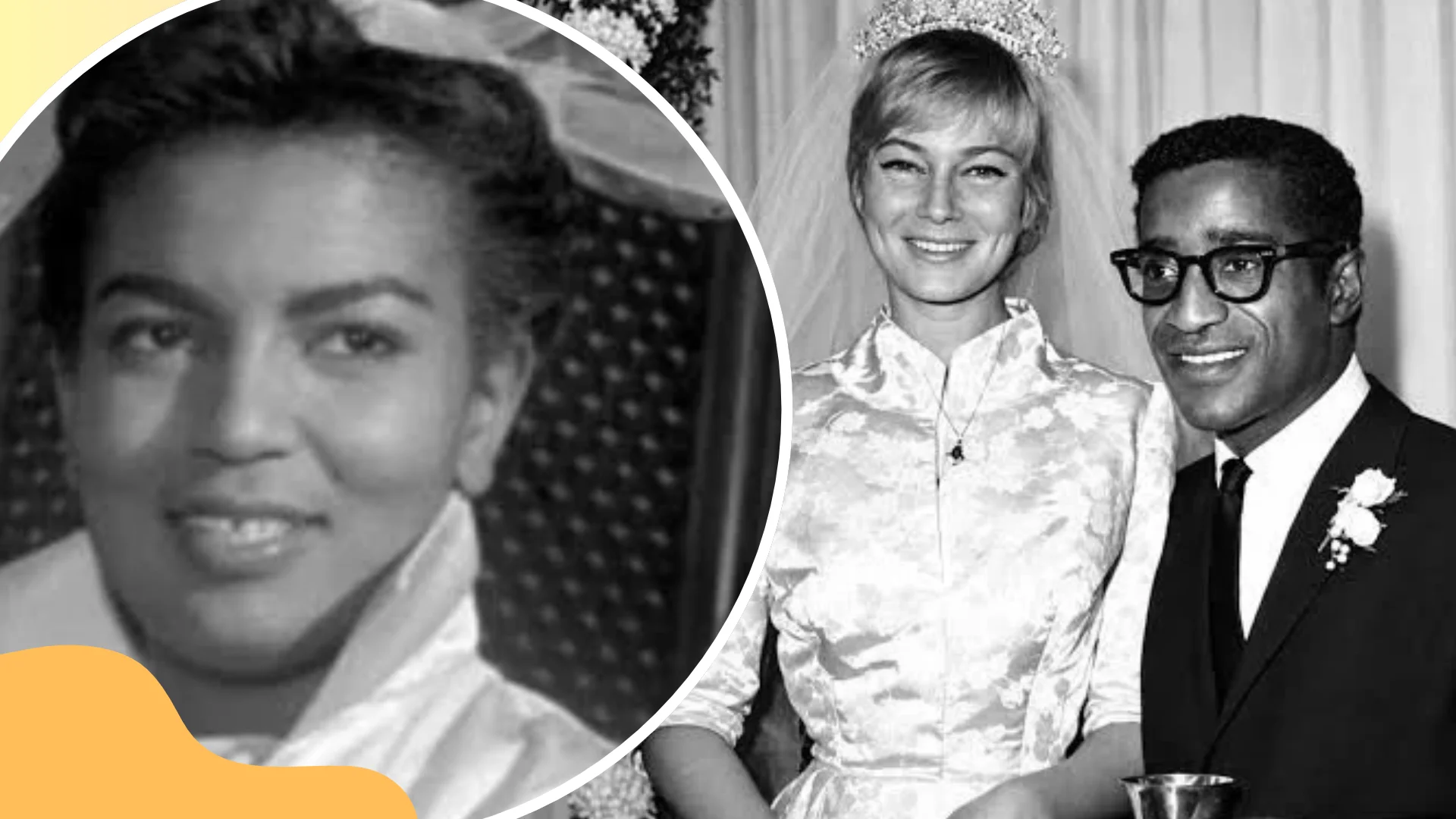
Loray White was an American dancer, singer, and actress who spent much of her working life in the nightclub circuit of the 1950s. Her name survives in popular memory for one reason above all others: on January 10, 1958, she became the first wife of Sammy Davis Jr., one of the most celebrated entertainers of the twentieth century. The marriage lasted barely longer than a year, and by almost every account it was a union shaped by outside pressure rather than romance. Even so, the story of Loray White deserves more attention than a single line in a famous man’s biography.
Public records give a thin but consistent outline. Entertainment databases list her as an actress with a handful of credits, archival collections in Las Vegas describe her as a dancer, and biographers of Davis mention her as the woman he wed during one of the most turbulent stretches of his career. What follows is a careful look at what is actually known about Loray White, what remains uncertain, and why a short marriage from the late 1950s continues to generate curiosity today.
Loray White’s Early Life and Houston Roots
According to entertainment database records, Loray White was born on November 27, 1934, in Houston, Texas. Some biographical write-ups give her full name as Loray Betty White, and a few reference works list additional name variations, though those details are not consistent from one source to the next. Beyond the date and place of birth, documentation of her childhood is sparse, and anyone writing about her has to be honest about that gap rather than filling it with invention.
What can be said is that a young Black woman born in Houston in the mid-1930s grew up in a segregated America where opportunities in entertainment were narrow and often dangerous to pursue. Performers from Texas and the broader South frequently made their way west toward Los Angeles and Las Vegas, where the nightclub economy offered paying work even if it came with indignities. Loray White appears to have followed a version of that path, arriving in the entertainment world as a teenager or young adult and building a modest career on stage before she ever met Davis.
A Career in Dance, Song, and Screen Work
Loray White was not a single-talent performer. Sources describe her variously as a dancer, a singer, and an actress, and that mix was typical of the working entertainers of her era, who needed to hold a stage in several ways to keep bookings coming in. Archival material connected to the University of Nevada, Las Vegas, identifies her as a dancer, which fits the picture of a woman working the Strip’s showrooms during the boom years of the 1950s.
Her screen record is brief. Entertainment databases credit her with appearances in The Notorious Cleopatra and Miss Nymphet’s Zap-In, both dated to 1970, along with an earlier listing connected to a 1956 production featuring Lionel Hampton and Herb Jeffries. These were not the kind of roles that make a performer a household name, and nothing suggests Loray White ever became a headliner. Still, the credits show that her connection to show business ran deeper than her marriage, and that she continued to pursue performing work in the years after her divorce.
Las Vegas in the 1950s: The World Loray White Worked In
To understand Loray White, it helps to understand the city where she worked. Las Vegas in the 1950s was a place of glittering contradictions. The casinos on the Strip booked Black entertainers as top-billed acts, yet many of those same performers were barred from staying in the hotels where they performed, eating in the dining rooms, or gambling at the tables. Stars such as Davis headlined at the Sands and then retreated to segregated lodging on the west side of town. The color line did not bend for talent, no matter how large the marquee letters were.
Within that environment, singers and dancers like Loray White occupied a precarious position. The showrooms offered steady work, and the proximity to famous names created chances for connection and advancement. At the same time, the business was controlled by powerful men with their own agendas, and performers had little protection if they found themselves on the wrong side of that power. Accounts of her life place her at the Silver Slipper, a casino venue close to the Sands, which put her within easy reach of Davis and his circle.
Why Sammy Davis Jr. Married Loray White
The reason Loray White entered the national story is tied to a scandal that nearly derailed Davis. In the late 1950s, he was dating Kim Novak, then one of Columbia Pictures’ biggest stars, at a time when interracial relationships were taboo in mainstream America and illegal to formalize in many states. Reports that have circulated for decades say Columbia studio chief Harry Cohn was furious about the pairing and that threats, some allegedly tied to organized crime figures, were directed at Davis.
According to those accounts, the solution presented to Davis was to marry a Black woman quickly, which would defuse the controversy and protect both his safety and his career. Davis reportedly turned to Loray White, a performer he knew from the Las Vegas club scene. It is important to note that the details of the threats come largely from secondhand retellings and from Davis’s own memoir, so they should be treated as the accepted narrative rather than as courtroom-proven fact. What nearly every telling agrees on is that the marriage was a practical arrangement. Loray White agreed to it, and the two were wed within a remarkably short stretch of time.
The Wedding at the Sands Hotel
The wedding took place in Las Vegas at the Sands Hotel, the property where Davis was a marquee draw. Most sources date the ceremony to January 10, 1958, although a few accounts say January 11, a discrepancy that is common when events took place late at night or were recorded after the fact. The ceremony itself was brief and, by contemporary descriptions, more subdued than the typical celebrity wedding. The Sands later became legendary as the home base of the Rat Pack, but in this moment it hosted something far more complicated than a celebration.
For Loray White, the wedding meant instant visibility. Newspapers noted that the entertainer had taken a bride, and the public learned her name overnight. Many readers at the time would have had no idea about the pressures behind the union. To them, it looked like a straightforward marriage between a rising star and a showgirl, which is exactly the impression the arrangement was meant to create. The gap between that public image and the private reality is a major reason the story still fascinates people.
Life Inside the Marriage
Descriptions of the marriage between Loray White and Davis consistently suggest that it never developed into a conventional household. Davis was constantly on the road, filming, recording, and performing, and the pair appear to have spent little time living as a couple in any ordinary sense. Several accounts say they were rarely together after the wedding, and the emotional core of a traditional marriage seems to have been absent from the start.
It is worth being careful here. Because the arrangement was widely understood to be one of convenience, there is a temptation among writers to flatten Loray White into a prop in someone else’s drama. The evidence does not support that reduction. She was an adult performer who chose under difficult circumstances, in a time when the options available to Black women in entertainment were limited. Whatever her private motives, she stepped into a high-pressure situation and carried the public role assigned to her. Her own voice rarely appears in the historical record, which means much of what is said about her inner life is inference rather than documentation.
The Divorce and Its Aftermath
The marriage ended quickly. Some accounts say Loray White filed for divorce in the fall of 1958, only months after the wedding, and entertainment database records list the end of the marriage as April 23, 1959. That timeline puts the union at roughly fifteen months from start to finish, a span that included very little shared life. As with other parts of her story, exact dates vary between sources, so anyone citing them should treat the broad outline as reliable and the specific day-level details with caution.
Financial terms of the divorce are another area where reports diverge. Various websites mention settlements and payments, but the figures are inconsistent and rarely traced to a primary document, so they are best left out of any serious account. What matters is that the dissolution was handled without the kind of public spectacle that had surrounded the original scandal. The arrangement had done its job, the cameras moved on, and Loray White largely slipped out of the national spotlight at the very moment her name had first reached it.
How Sammy Davis Jr. Moved On
Davis went on to marry again, and his next marriage drew even more controversy than the first. In November 1960 he wed Swedish actress May Britt, a union that sparked public backlash and reportedly led political advisers around John F. Kennedy’s campaign to ask him to delay the ceremony until after the election. The marriage to Britt produced a daughter and two adopted sons before ending in divorce, and Davis later married dancer Altovise Gore in 1970, a marriage that lasted until he died in 1990.
Set against those later chapters, the marriage to Loray White looks like an opening act in a lifetime of public scrutiny over Davis’s personal choices. It also highlights a painful truth about the era: a man at the height of his fame could still be pushed into a marriage by forces outside his control. Davis reflected on the period in his autobiography Yes I Can, and documentaries and biographies have revisited the broader arc of his story ever since. In each retelling, Loray White appears as a figure at the edge of the frame, essential to the plot but rarely given room to speak.
Separating Fact From Rumor in Loray White Accounts
Anyone who looks into Loray White online will quickly notice how many articles repeat the same few claims, often word for word. That repetition can create a false sense of certainty. Several widely shared details, including specifics about her family, her earlier relationships, and her life after the divorce, appear mainly on lightly sourced websites and not in archives, court filings, or contemporaneous newspaper reporting. When a claim cannot be traced back to anything more solid than another website, it is wise to treat it as unconfirmed.
The most notable gap concerns her later years. Some pages state definitively where she lived or whether she is still alive, yet none of those assertions is backed by a verifiable record. The honest position is that her current status is unknown. A responsible account of Loray White acknowledges the verified facts, namely her birth in Houston, her work as a performer, her marriage to Davis, and its end in 1959, and labels everything else as unsettled. Respecting that boundary is part of treating her as a real person and not as a character in a legend.
Why Loray White Still Draws Curiosity
There are a few clear reasons people keep asking about Loray White. The first is the sheer drama of the circumstances. A marriage arranged to calm a studio executive and shield a star from alleged threats reads like the plot of a film, and that makes it endlessly shareable. The second is the enduring popularity of Sammy Davis Jr. himself. As interest in the Rat Pack, classic Las Vegas, and mid-century Hollywood continues, so does interest in the people who moved through those worlds, including the ones who appeared only briefly.
A third reason is more reflective. Modern readers are increasingly drawn to the stories of women who were present at pivotal moments in history but left out of the main narrative. Loray White fits that pattern. She was neither a villain nor a headline-maker in her own right, yet her name is attached to a moment that reveals how deeply race, power, and public image were entangled in entertainment during the 1950s. Curiosity about her is, in many ways, curiosity about everything the standard biography skipped.
Loray White’s Place in Entertainment History
Measured by screen time or chart positions, Loray White’s footprint is small. Measured by what her story illuminates, it is considerably larger. Her marriage to Davis offers a window into how studios, hotels, and powerful intermediaries shaped the private lives of performers, and into the unequal rules applied to Black artists even at the peak of their success. The fact that a young dancer could be drawn into a high-stakes arrangement because of someone else’s relationship says a great deal about the climate of the time.
Her story also serves as a reminder that history is full of people who played crucial but understated roles. Biographies tend to center the famous, while those who stood next to them for a season fade into footnotes. Revisiting the life of Loray White is a way of restoring some dignity and detail to a person who spent one of the most publicized years of her life following a script written by others. Even with major gaps in the record, her name remains a useful entry point into conversations about segregation, celebrity, and the hidden costs of fame.
Conclusion
Loray White was a performer first and a headline second. Born in Houston in 1934, she worked as a dancer, singer, and actress, built a modest résumé, and became the wife of Sammy Davis Jr. in a ceremony at the Sands Hotel that reflected the intense pressures of its moment. The marriage ended in 1959, and the details of her later life remain largely undocumented.
What can be said with confidence is that her story is more than a trivia answer. It reflects the strange mix of glamour and constraint that defined entertainment in the 1950s, and it shows how easily a person can become a symbol without ever being allowed to speak for herself. As interest in classic Hollywood and Las Vegas history continues to grow, the name Loray White will likely keep resurfacing, and the best way to honor that curiosity is to stay close to what the record supports and to admit plainly where it falls silent.
Frequently Asked Questions
Who is Loray White?
Loray White was an American dancer, singer, and actress born in Houston, Texas, in 1934. She is best known as the first wife of entertainer Sammy Davis Jr.
Why did Loray White marry Sammy Davis Jr.?
Widely repeated accounts say the 1958 marriage was arranged to ease pressure and threats surrounding Davis’s relationship with actress Kim Novak. Those details come mostly from secondhand retellings and Davis’s own memoir.
How long were Loray White and Sammy Davis Jr. married?
They married in January 1958 and the marriage ended in April 1959, a span of roughly fifteen months. Exact dates vary slightly between sources.
What did Loray White do for a living?
She worked as a performer in Las Vegas and beyond, and entertainment databases credit her with a few screen appearances, including two titles from 1970. Archival material describes her as a dancer.
Where is Loray White today?
No verified record confirms where she lives or whether she is still alive. Claims on that point appear only on lightly sourced websites.
Leave a Reply